
Patios and pergolas in Hobart: see yours on your home and get a local price
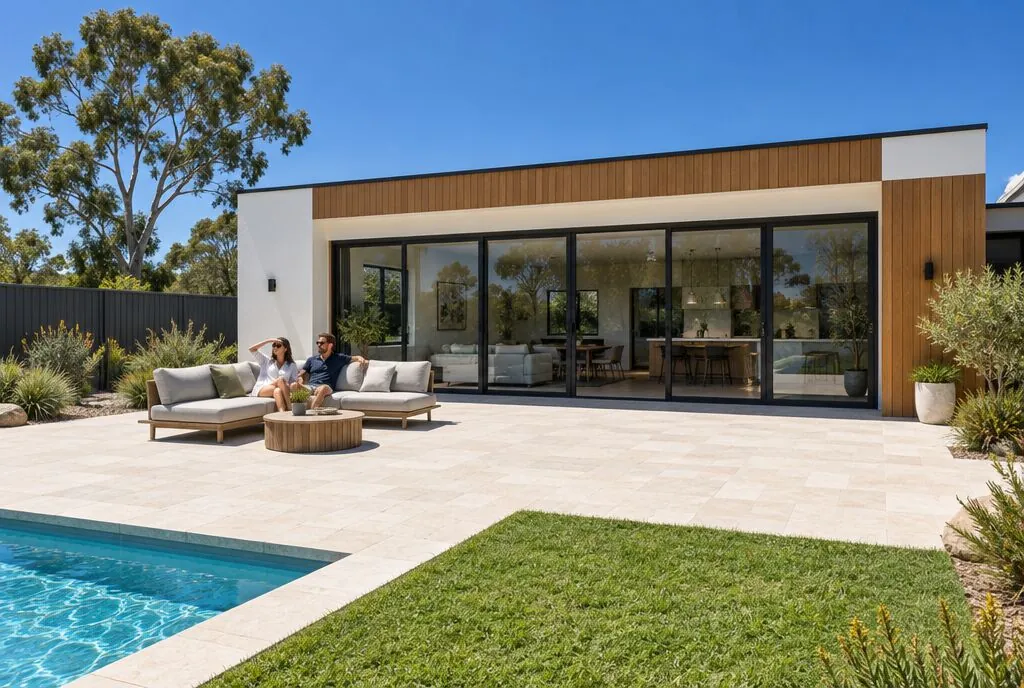
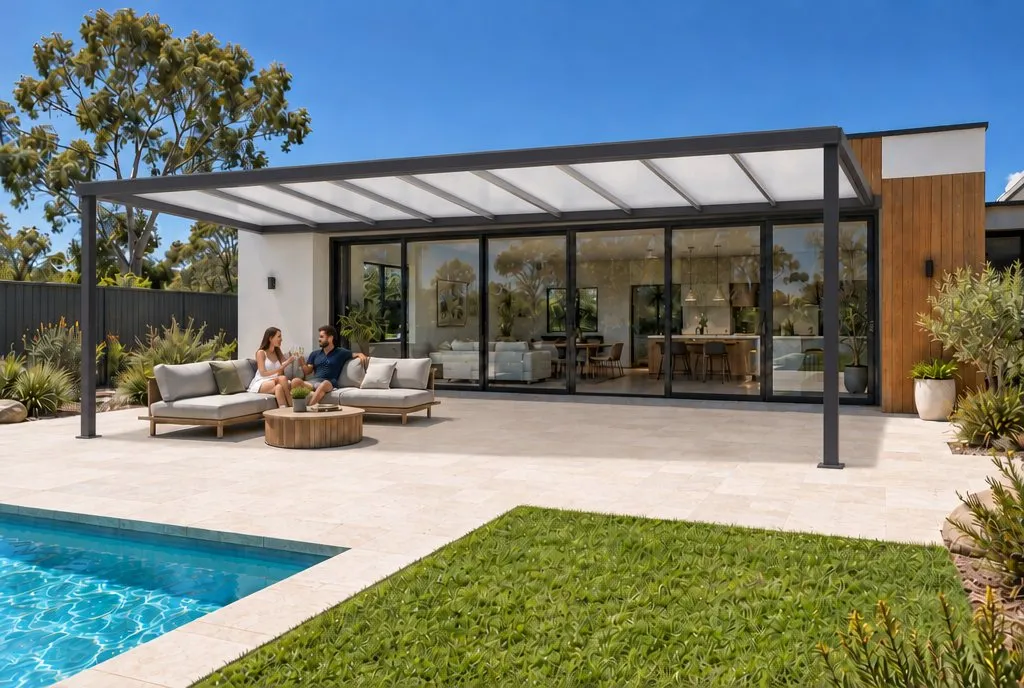 BeforePolycarbonate Roof Patio
Patios in Hobart are less about escaping heat and more about using the yard in cool, breezy, changeable weather. In 2026 a 6 × 4.5 m flat Colorbond patio costs about $13,000 to $15,500 installed, and a polycarbonate roof about $12,000 to $14,000.
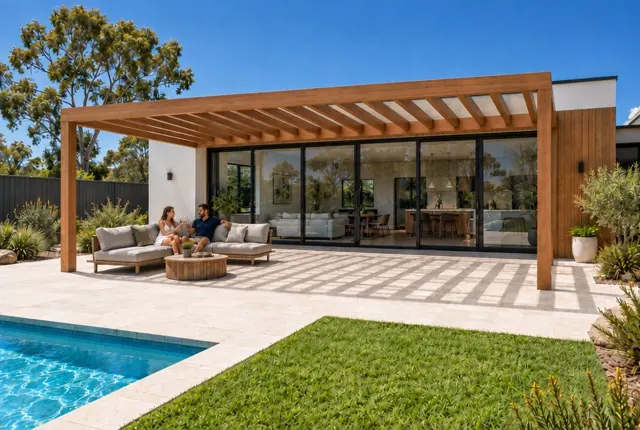
Hobart people use patio and pergola side by side, and some say verandah for a roof across an older home. This page covers solid and clear roofs. For open beams, slats or an opening louvre roof, see pergolas in Hobart.
What does a patio cost in Hobart in 2026?
The table shows our indicative installed prices for every style in Tasmania, for a 6 × 4.5 m structure. They are rounded and include GST.
| Style | 3 × 3 m | 5 × 4 m | 6 × 4.5 m |
|---|---|---|---|
| Insulated Roof Patio | $13,000 to $15,000 | $13,000 to $15,000 | $16,500 to $19,500 |
| Flat Roof Colorbond Patio | $8,500 to $10,000 | $9,500 to $11,500 | $13,000 to $15,500 |
| Gable Roof Patio | $13,000 to $15,500 | $13,000 to $15,500 | $18,000 to $21,000 |
| Skillion Patio | $9,000 to $10,500 | $10,000 to $12,000 | $13,500 to $16,000 |
| Adjustable Louvre Pergola | $15,000 to $17,500 | $23,000 to $27,000 | $31,500 to $36,500 |
| Open Timber Pergola | $7,000 to $8,500 | $8,000 to $9,000 | $10,500 to $12,500 |
| Polycarbonate Roof Patio | $8,000 to $9,500 | $9,000 to $10,500 | $12,000 to $14,000 |
| Curved Roof Patio | $12,500 to $14,500 | $12,500 to $14,500 | $16,000 to $19,000 |
| Fixed Aluminium Slat Pergola | $11,500 to $13,500 | $11,500 to $13,500 | $14,500 to $17,500 |
| Pyramid Roof Pavilion | $14,500 to $17,000 | $16,500 to $19,500 | $22,500 to $26,000 |
Indicative installed prices in Tasmania, including GST, rounded. Pavilion is freestanding, the others attached to the house. Updated 28 October 2026.
Tasmania sits in the upper middle of the national range. In Hobart, slope is the big site factor. Many homes sit on sloping blocks, which can mean taller posts on one side, stepped footings and harder access.
Approvals also depend on size, as explained below, so a smaller patio can save paperwork as well as money.
What is Hobart's weather really like?
Mild, breezy and changeable. The Bureau of Meteorology's long record at Hobart (Ellerslie Road) shows:
- Mild summers: average maximums of 21.8 °C in January and February. Only about 6 days a year reach 30 °C.
- Hot spells still happen: the record is 41.8 °C, on 4 January 2013.
- Cool winters: the July average minimum is 4.7 °C, with about 13 nights a year at 2 °C or below.
- Rain: about 611 mm a year, spread over about 87 rain days. October is the wettest month.
- Sun: about 5.9 hours of sunshine a day on average across the year.
- Wind: the 3 pm average wind speed peaks in summer, at about 19 km/h in December and January.
That last point matters. Hobart's windiest afternoons tend to fall in the months you most want to sit outside. The Bureau also describes the Bridgewater Jerry, a cold breeze that carries fog down the Derwent on clear autumn and winter nights.
Which patio styles suit Hobart?
A Hobart patio has three jobs: keep the rain off, block the wind and let in as much light as possible. A dark roof over the back windows can make the house feel cold.
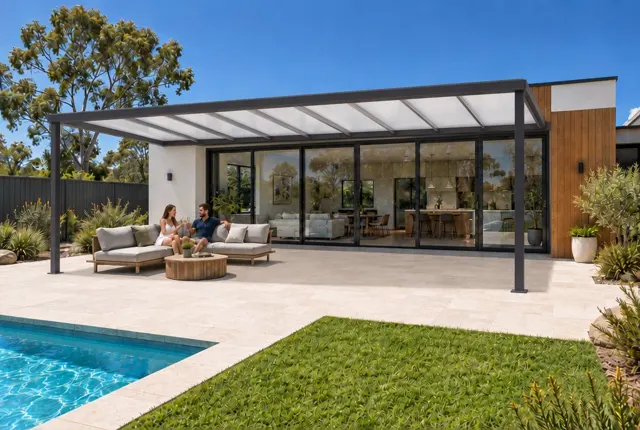
- Polycarbonate roof: a clear or opal sheet keeps rain off while letting daylight through. It suits a south-facing yard or a living room that needs light.
- Skillion: raised at the outer edge, it lets the low winter sun reach the house. A single slope also sheds rain simply.
- Gable roof: matches the pitched roofs of many older Hobart homes and gives a generous ceiling height.
- Insulated roof: worth it if the patio faces west and catches the summer afternoon sun.
Our guide to polycarbonate vs Colorbond roofs compares light, heat and noise. Side blinds or screens on the windward side are often the best value extra in Hobart. Our patio extras cost guide lists typical prices.
BeforePolycarbonate Roof PatioDo you need a permit for a patio in Hobart?
It depends on size. Tasmania sorts building work into categories under the Director's Determination, and a roofed verandah or patio moves up the categories as it grows.
- Low risk, Category 1: a roofed verandah up to 9 m², with a floor no more than 1 m above the ground. An owner or competent person can build it, but council must be notified.
- Low risk, Category 2: a roofed verandah up to 18 m², built by a licensed builder, with council notified.
- Larger work: anything bigger moves up to notifiable work or permit work.
A typical 6 × 4.5 m patio is 27 m², so it goes beyond low risk work. Glenorchy City Council explains that for notifiable work, your building surveyor manages the process. For permit work, the council assesses and issues the permit, which is valid for 12 months.
Approval in Tasmania, in short
Tasmania sorts building work by risk. A pergola with no roof or only shade cloth, up to 36 m2 and 3.5 m high, is low risk and needs no building permit. A roofed porch or verandah is low risk up to 9 m2 for an owner, or up to 18 m2 if a licensed builder does it, with the floor under 1 m high. Bigger structures move to notifiable work (a building surveyor issues a Certificate of Likely Compliance) or permit work (council building permit). You still need a planning permit or written confirmation from council that one is not needed. Installers usually coordinate the building surveyor.
Read the Tasmania approval guide. Your installer usually handles the paperwork.
Our guide to council approval in Tasmania explains each category. A planning permit may still be needed, so check with your council.
What is different about building in Hobart?
Slopes and views
Many Hobart homes sit on hillsides with views over the Derwent. A patio on the downhill side can need tall posts and engineered footings. A raised skillion can frame the view rather than block it.
Older homes
Hobart has many older weatherboard and brick homes. A gable or curved roof often sits more naturally against them than a flat roof does.
Bushfire
Some Hobart suburbs back onto bushland on the slopes of kunanyi / Mount Wellington and the eastern shore hills. If your block is in a bushfire prone area, ask whether your patio must meet a Bushfire Attack Level (BAL) before choosing materials.
How it works with Backyard Mate
We are not a builder and we do not install patios. We show you the design and an indicative price first.
- Upload a photo of your backyard and pick a style.
- See it on your own house in about 30 seconds, with an indicative Tasmanian price.
- Decide what happens next. If you want a quote, one local installer who services your suburb calls you, and only one.
Common questions
How much does a patio cost in Hobart?
A 6 × 4.5 m flat Colorbond patio is about $13,000 to $15,500 installed in Tasmania, and a polycarbonate roof of the same size is about $12,000 to $14,000. These are indicative ranges including GST. A site measure and quote sets the real price.
Do I need a building permit for a patio in Hobart?
It depends on size. Under Tasmania's Director's Determination, a roofed verandah up to 9 m² can be low risk work, and up to 18 m² with a licensed builder. A typical 27 m² patio moves into notifiable or permit work, handled by a building surveyor or council.
What is the best patio roof for Hobart?
In Hobart you usually want shelter from wind and rain without losing light. A clear or opal polycarbonate roof, or a skillion raised at the outer edge, keeps the house brighter than a solid flat roof.
How windy is Hobart in summer?
The Bureau of Meteorology's Hobart records show the 3 pm average wind speed peaks in December, January and November, at about 19 km/h. Side blinds or screens on the windward side make a big difference.
Do I need sun protection under a patio in Hobart?
Yes. Hobart's summers are mild, but ARPANSA and Cancer Council advise sun protection whenever the UV index reaches 3 or above. A solid or tinted roof gives real shade on summer afternoons.
Keep reading
Sources
- Climate statistics for Australian locations: Hobart (Ellerslie Road) | Bureau of Meteorology
- Climate statistics for Australian locations: Hobart (Ellerslie Road) summary | Bureau of Meteorology
- Meet the locals: when the weather gives the place character | Bureau of Meteorology
- Director's Determination: Categories of Building and Demolition Work (version 1.4) | Kingborough Council
- Do I need a Building Permit? | Glenorchy City Council
- Cancer Council and ARPANSA stress importance of improved understanding as UV reaches extreme levels this summer | ARPANSA
Prices on this page come from Backyard Mate's pricing for each state and are indicative only. Rules and products change: check with your council and installer before you build.