
Roofed pergolas and patios in Sydney: see yours first, then get a local price
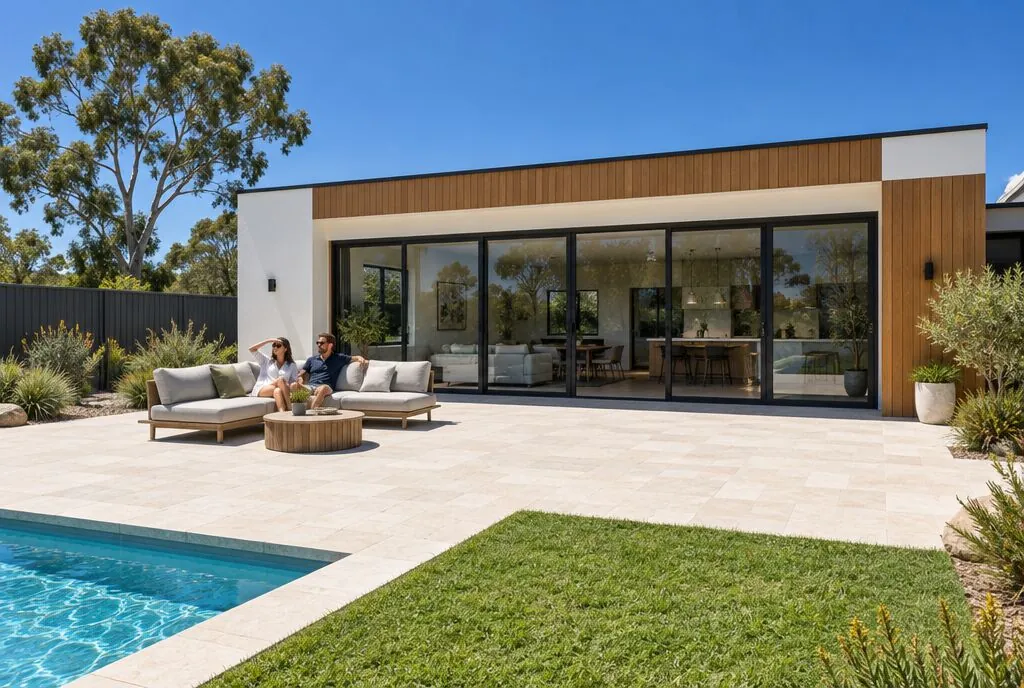
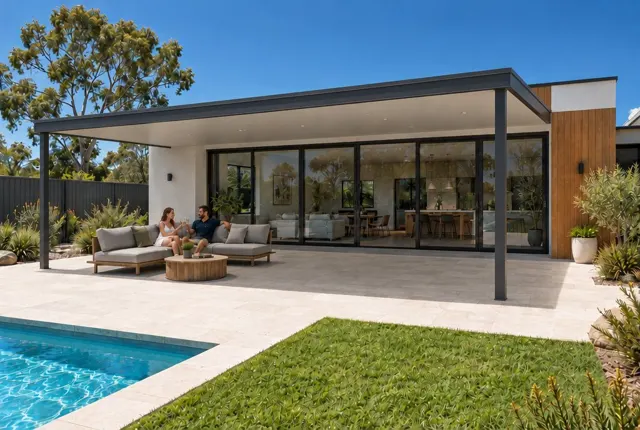
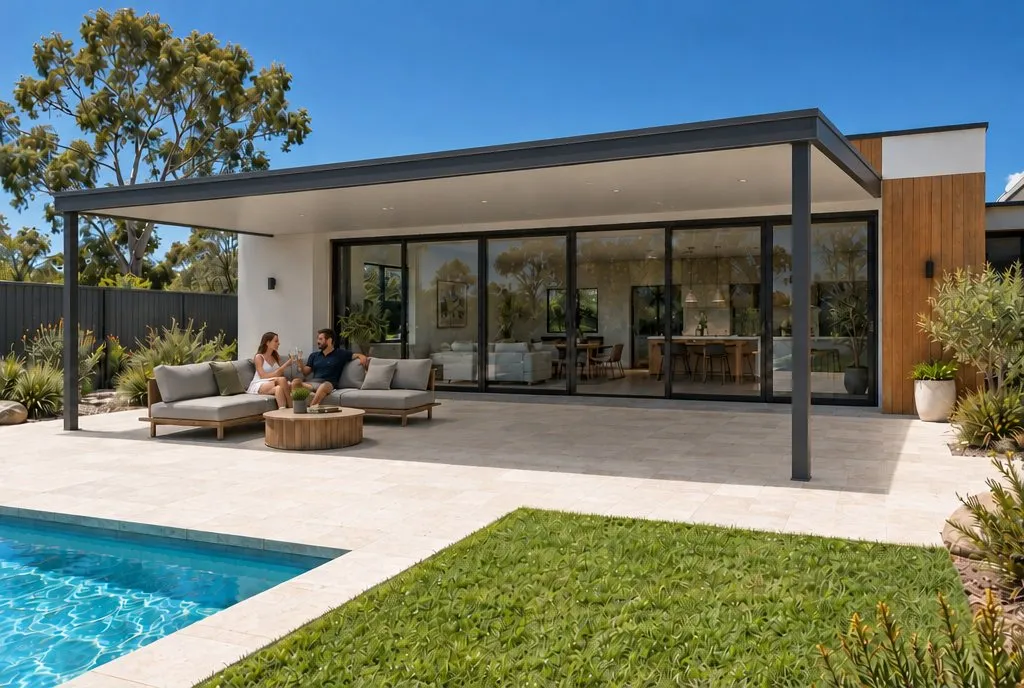 BeforeSkillion Patio
In Sydney, most people call a roofed outdoor area a pergola, and patio is the second word you will hear. Whatever you call it, a 6 × 4.5 m flat Colorbond roof costs about $13,500 to $16,000 installed in 2026.
This page is about solid roofs: Colorbond, insulated and polycarbonate. If you are picturing open beams, fixed slats or an opening louvre roof, start with our page on pergolas in Sydney instead.
What does a patio or roofed pergola cost in Sydney?
The table shows our indicative installed prices for every style in NSW, for a 6 × 4.5 m structure. They are rounded and include GST.
| Style | 3 × 3 m | 5 × 4 m | 6 × 4.5 m |
|---|---|---|---|
| Insulated Roof Patio | $13,000 to $15,500 | $13,000 to $15,500 | $17,000 to $20,000 |
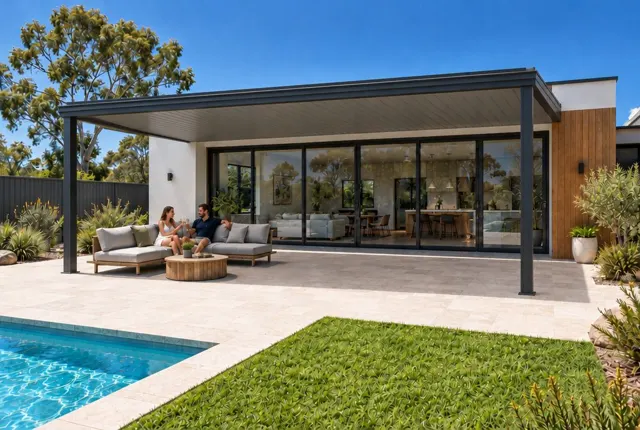
| Flat Roof Colorbond Patio | $8,500 to $10,000 | $10,000 to $11,500 | $13,500 to $16,000 |
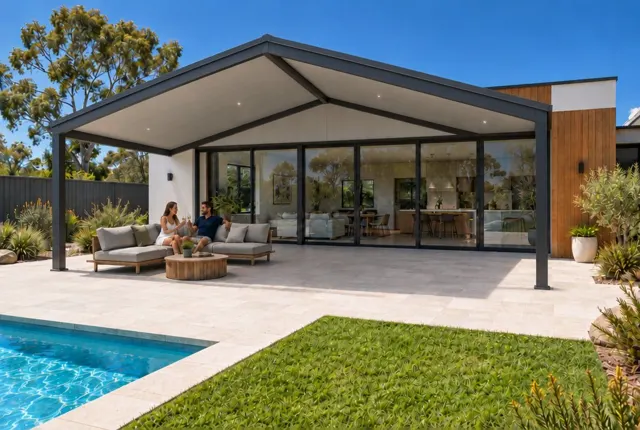
| Gable Roof Patio | $13,500 to $16,000 | $13,500 to $16,000 | $18,500 to $21,500 |
| Skillion Patio | $9,500 to $11,000 | $10,500 to $12,000 | $14,000 to $16,500 |
| Adjustable Louvre Pergola | $15,500 to $18,000 | $24,000 to $28,000 | $32,000 to $37,500 |
| Open Timber Pergola | $7,500 to $8,500 | $8,000 to $9,500 | $11,000 to $12,500 |
| Polycarbonate Roof Patio | $8,000 to $9,500 | $9,000 to $10,500 | $12,500 to $14,500 |
| Curved Roof Patio | $12,500 to $15,000 | $12,500 to $15,000 | $16,500 to $19,500 |
| Fixed Aluminium Slat Pergola | $11,500 to $13,500 | $11,500 to $13,500 | $15,000 to $18,000 |
| Pyramid Roof Pavilion | $15,000 to $17,500 | $17,000 to $20,000 | $23,000 to $27,000 |
Indicative installed prices in New South Wales, including GST, rounded. Pavilion is freestanding, the others attached to the house. Updated 28 October 2026.
NSW is one of the dearer states to build in. Sydney sites add their own costs: tight side access on terraces and semis, sloping blocks, and approvals.
Size is the one cost lever that is special to NSW. A structure of 25 m² or less may avoid a council application, as explained below. A 5 × 4 m flat roof is about $10,000 to $11,500, against $13,500 to $16,000 for 6 × 4.5 m.
Can you skip council approval in Sydney?
Sometimes. NSW lets some patios go ahead as exempt development, with no council application, if they meet every standard. The NSW Planning Portal lists the main ones.
- Area: no more than 25 m² per structure.
- Total on the lot: 25 m² on lots of 300 m² or less. On larger lots, 15 % of the ground floor area of the house.
- Height: no more than 3 m above existing ground level at the highest point.
- Setback: at least 900 mm from a side or rear boundary in most zones, and 5 m in some rural zones.
- Street: not beyond the building line of any road frontage.
- Metal roofing: low reflective, factory pre-coloured materials.
A 6 × 4.5 m patio is 27 m², so it is already over the limit. In that case you need a development application or a complying development certificate.
Approval in New South Wales, in short
In NSW a patio, pergola, deck or verandah can be built with no approval at all if it meets the exempt development rules in the state Codes SEPP: behind the front building line, at least 900 mm from side and rear boundaries in most residential zones, no more than 25 m2, no more than 3 m high, and roofed structures must not rise above the house gutter and must drain into the existing stormwater system. If it does not fit, you can get a fast Complying Development Certificate from the council or a registered certifier, or lodge a development application with the council. Heritage and bushfire land add limits. Many patio installers organise the CDC or DA for you.
Read the New South Wales approval guide. Your installer usually handles the paperwork.
Our guide to council approval in NSW walks through each pathway.
How does Sydney's weather affect a roof?
Sydney's weather is milder than Perth's or Adelaide's, but it is wetter and stormier. The Bureau of Meteorology's long record at Observatory Hill shows the pattern.
- Summer: average maximums of 26.0 °C in January and 25.8 °C in February. Only about 3 days a year reach 35 °C.
- Record heat: 45.8 °C on 18 January 2013.
- Rain: about 1,213 mm a year over roughly 100 rain days. June and March are the wettest months.
- Downpours: the highest daily total is 327.6 mm, on 6 August 1986.
These figures are for the harbour, so suburbs further inland can run hotter. Sydney also has the southerly buster. The Bureau defines it as an abrupt change with southerly winds above 54 km/h. The temperature must also drop at least 5 °C within three hours.
Which roofed styles suit Sydney?
Rain and humidity matter here as much as heat. A good Sydney roof sheds a heavy downpour quickly and stays firmly fixed when the southerly hits.
- Skillion: a single slope sheds water fast. Raised at the outer edge, it lets light back into the rooms of a narrow terrace or semi.
- Insulated roof: keeps the space cooler on humid summer days. Insulated panels are also usually quieter than a single steel sheet in heavy rain.
- Flat Colorbond roof: the budget choice. Ask for gutters and downpipes sized for Sydney downpours.
- Polycarbonate roof: lets daylight into a small courtyard that would otherwise feel dark.
BeforeSkillion PatioWhat is different about building in Sydney?
Terraces, semis and heritage streets
Inner Sydney has many terraces and semis with narrow rear yards. Small yards suit a lighter roof that keeps the house bright. Our small backyard patio ideas cover layouts that work.
If your home is in a heritage conservation area, exempt development must sit behind the building line of any road frontage. Back yard structures are the usual result.
Bush fire prone land
Many Sydney suburbs back onto bushland. The NSW Rural Fire Service has an online tool to check whether your property is designated bush fire prone. You can also confirm it on your council's Section 10.7 planning certificate.
On bush fire prone land, an exempt structure less than 5 m from the house must be non-combustible. Any new works must comply with Planning for Bush Fire Protection.
How it works with Backyard Mate
We are not a builder and we do not install anything. We show you the design and an indicative price first.
- Upload a photo of your backyard and choose a roof style.
- See it on your own house in about 30 seconds, with an indicative NSW price.
- Decide what happens next. If you want a quote, one local installer who services your suburb calls you, and only one.
Common questions
How much does a roofed pergola or patio cost in Sydney?
A 6 × 4.5 m flat Colorbond roof is about $13,500 to $16,000 installed in NSW, and an insulated roof of the same size is about $17,000 to $20,000. These are indicative ranges including GST. A site measure and quote sets the real price.
Can I build a patio in Sydney without council approval?
Sometimes. Under the NSW exempt development rules a patio can be no more than 25 m², no more than 3 m high and, in most zones, at least 900 mm from the boundary. It must meet every other standard too, so check the NSW Planning Portal first.
What size patio can I build as exempt development in NSW?
No more than 25 m² per structure. On lots of 300 m² or less, the total for all such structures is 25 m². On larger lots it is 15 % of the ground floor area of the house.
Is a pergola the same as a patio in Sydney?
In everyday Sydney talk, a pergola can have an open frame or a solid roof, while patio is the less common word. This page covers solid roofs. Open, slatted and louvre roofs are on our Sydney pergolas page.
What happens if my Sydney home is on bush fire prone land?
For exempt development, a structure on bush fire prone land that is less than 5 m from the house must be made of non-combustible material. New works on bush fire prone land must also comply with Planning for Bush Fire Protection.
Keep reading
Sources
- Climate statistics for Australian locations: Sydney (Observatory Hill) | Bureau of Meteorology
- Meet the locals: when the weather gives the place character | Bureau of Meteorology
- Balconies, Decks and Patios | NSW Planning Portal
- Check if you're in bush fire prone land | NSW Rural Fire Service
Prices on this page come from Backyard Mate's pricing for each state and are indicative only. Rules and products change: check with your council and installer before you build.