Patios in Brisbane: see yours on your home and get a local price
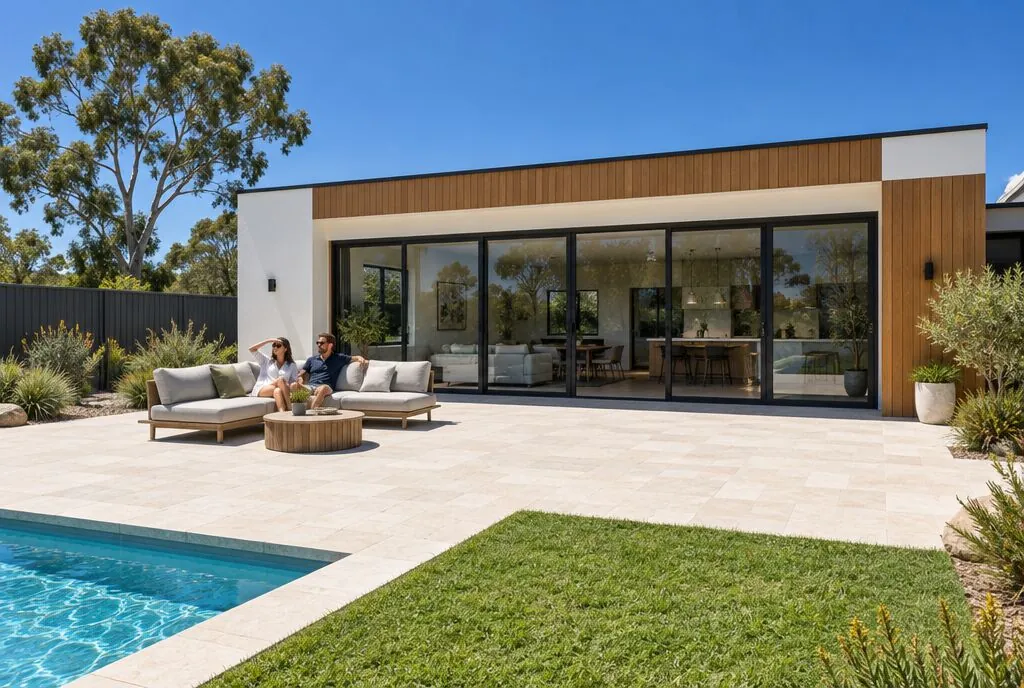
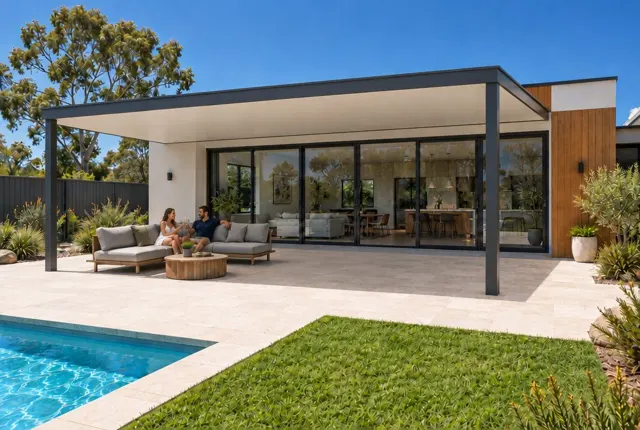
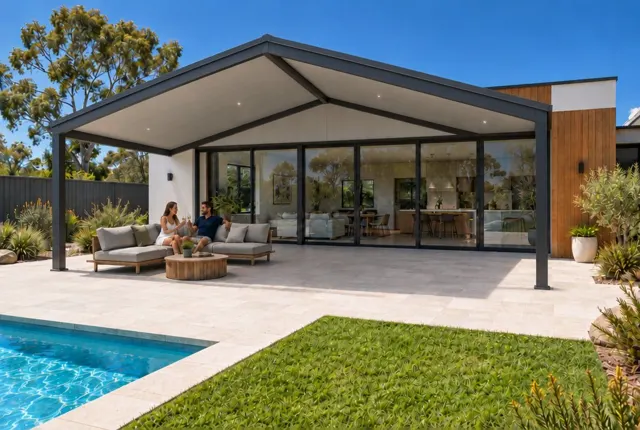
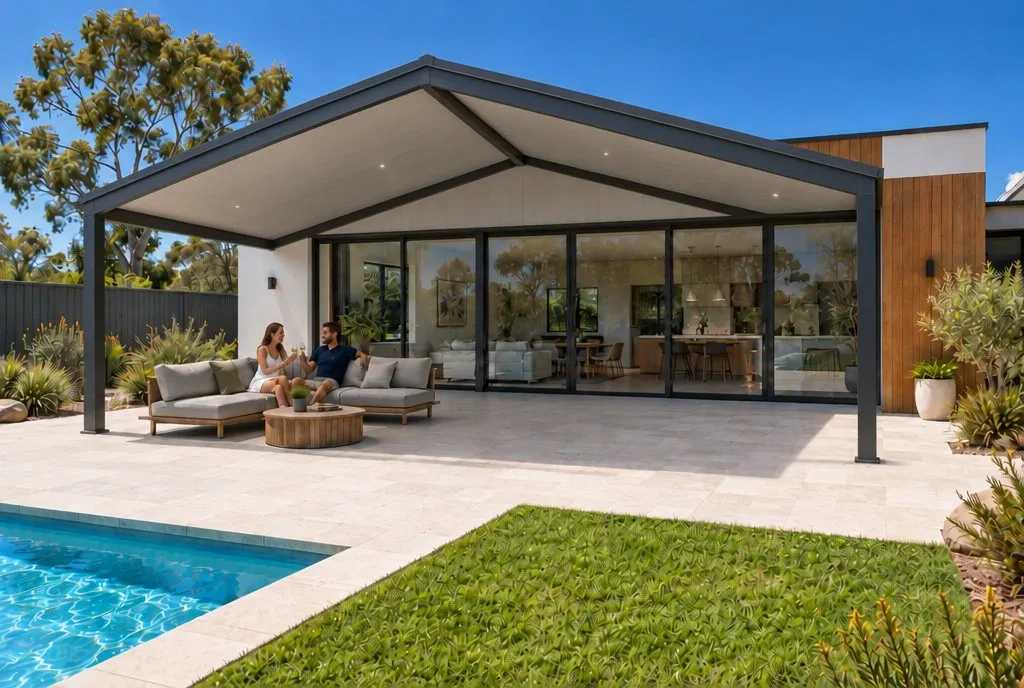 BeforeGable Roof Patio
Patios in Brisbane are built for long, humid summers and heavy storm rain. In 2026 a 6 × 4.5 m flat Colorbond patio costs about $12,500 to $15,000 installed, and a gable roof about $17,000 to $20,000.
Brisbane people say patio for a roofed area off the back of the house, and pergola for an open or opening roof. For slats, timber beams or louvres, see our page on pergolas in Brisbane.
What does a patio cost in Brisbane in 2026?
The table shows our indicative installed prices for every style in Queensland, for a 6 × 4.5 m structure. They are rounded and include GST.
| Style | 3 × 3 m | 5 × 4 m | 6 × 4.5 m |
|---|---|---|---|
| Insulated Roof Patio | $12,500 to $14,500 | $12,500 to $14,500 | $16,000 to $19,000 |
| Flat Roof Colorbond Patio | $8,000 to $9,500 | $9,500 to $11,000 | $12,500 to $15,000 |
| Gable Roof Patio | $12,500 to $15,000 | $13,000 to $15,000 | $17,000 to $20,000 |
| Skillion Patio | $8,500 to $10,000 | $9,500 to $11,500 | $13,000 to $15,500 |
| Adjustable Louvre Pergola | $14,500 to $17,000 | $22,500 to $26,000 | $30,000 to $35,500 |
| Open Timber Pergola | $7,000 to $8,000 | $7,500 to $9,000 | $10,000 to $12,000 |
| Polycarbonate Roof Patio | $7,500 to $9,000 | $8,500 to $10,000 | $11,500 to $13,500 |
| Curved Roof Patio | $12,000 to $14,000 | $12,000 to $14,000 | $15,500 to $18,000 |
| Fixed Aluminium Slat Pergola | $11,000 to $13,000 | $11,000 to $13,000 | $14,000 to $16,500 |
| Pyramid Roof Pavilion | $14,000 to $16,500 | $16,000 to $18,500 | $21,500 to $25,000 |
Indicative installed prices in Queensland, including GST, rounded. Pavilion is freestanding, the others attached to the house. Updated 28 October 2026.
Queensland sits in the middle of the national price range. In Brisbane, height is the cost driver to watch. A patio joined to a high-set Queenslander needs much taller posts than one beside a slab-on-ground house.
Sloping blocks, stairs, fill and flood-affected sites can also change the footings. Approvals in a character area add time and fees.
How does Brisbane's climate shape a patio?
Brisbane is warm for most of the year and wet in summer. The Bureau of Meteorology's Brisbane station shows the pattern.
- Long, warm summers: average maximums of 30.4 °C in January and 30.2 °C in February. About 75 days a year reach 30 °C.
- Few scorchers: only about 4 days a year reach 35 °C. The heat is steady and humid rather than extreme.
- Rain: about 1,056 mm a year. February is the wettest month, at about 172 mm.
- Downpours: 887 mm fell in February 2022 alone, and 275.2 mm fell on 10 March 2025.
- Winter: the July average minimum is a mild 10.6 °C.
The Bureau also notes Brisbane's Ekka winds. West to south-westerlies become more common from June to late September, so a winter patio may need a screen on its western side.
Which patio styles suit Brisbane?
In Brisbane, airflow matters as much as shade. A roof that traps humid air feels sticky even on a 30 °C day.
- Gable roof: the extra height lets hot air rise and escape. It also suits the pitched roofs of Queenslanders and other character homes.
- Insulated roof: cuts the heat coming through the roof, and is usually quieter in a summer storm.
- Skillion: sheds heavy rain quickly with a single fall. It is a neat fit for a low-set brick home.
- Flat Colorbond roof: the budget option. Make sure the fall and gutters can cope with a summer downpour.
Our guide to the best patio roof for a hot climate compares these roofs in more depth.
BeforeGable Roof PatioDo you need approval for a patio in Brisbane?
Almost always. Brisbane City Council lists when a deck can skip building approval. One condition is that the deck is not roofed. A roofed patio falls outside that exemption.
You arrange building approval through a licensed building certifier, not the council. The certifier can also ask for alternative boundary setbacks through a referral request.
Approval in Queensland, in short
In Queensland a roofed patio or verandah needs building approval from a private building certifier. Only very small structures avoid it, such as an unroofed, freestanding deck of 10 m2 or less and 1 m high or less, or a small Class 10a structure of 10 m2 or less and 2.4 m high outside the cyclone area. Council is usually not the approver, but you may also need council planning approval if your property is in an overlay such as a character overlay, or a siting variation if the patio is close to a boundary. Patio companies in Queensland normally handle the certifier and approval for you.
Read the Queensland approval guide. Your installer usually handles the paperwork.
Our guide to council approval in Queensland covers certifiers and overlays in more detail.
What is different about building in Brisbane?
Queenslanders and character homes
Brisbane's Traditional building character overlay is intended to maintain the traditional, pre-1947 streetscape. If your changes do not comply with the overlay code, you need a development application. Council also says houses built before 1911 are to be retained, and extensions should not alter their original parts.
A rear patio that stays out of the street view is usually easier to approve. Check City Plan online to see whether your property is subject to an overlay.
High-set homes
Many Brisbane homes are built up off the ground. A patio can join the house at deck level, or sit lower over the yard. Our guide to a patio on a double-storey house explains the options and the extra cost of height.
Storm rain
With more than 170 mm of rain in an average February, drainage is part of the design. Ask where the downpipes will discharge, and whether the patio sits near any council stormwater infrastructure.
How it works with Backyard Mate
We are not a builder and we do not install patios. We show you the design and an indicative price first.
- Upload a photo of your backyard and pick a style.
- See it on your own house in about 30 seconds, with an indicative Queensland price.
- Decide what happens next. If you want a quote, one local installer who services your suburb calls you, and only one.
Common questions
How much does a patio cost in Brisbane?
A 6 × 4.5 m flat Colorbond patio is about $12,500 to $15,000 installed in Queensland, and a gable roof of the same size is about $17,000 to $20,000. These are indicative ranges including GST. A site measure and quote sets the real price.
Does a patio need approval in Brisbane?
Almost always. Brisbane City Council says a deck only avoids building approval if, among other things, it is not roofed. A roofed patio therefore needs building approval, which you arrange through a licensed building certifier.
Can I add a patio to a Queenslander?
Usually, yes, but check the overlays first. Brisbane's Traditional building character overlay protects the pre-1947 streetscape, so a development application may be needed if the work does not comply with the overlay code.
What is the best patio roof for Brisbane's humidity?
A gable roof lets hot, humid air rise and escape, and an insulated roof cuts the heat coming through. Both suit long Brisbane summers better than a low flat roof.
When is storm season a problem for patio building in Brisbane?
Brisbane's wettest months are February, March and January, so summer is when gutters and falls get tested. Building is possible all year, but a wet spell can push back concrete work.
Keep reading
Sources
- Climate statistics for Australian locations: Brisbane | Bureau of Meteorology
- Meet the locals: when the weather gives the place character | Bureau of Meteorology
- Decks and decking approvals | Brisbane City Council
- Heritage and character properties | Brisbane City Council
- Residential projects | Brisbane City Council
Prices on this page come from Backyard Mate's pricing for each state and are indicative only. Rules and products change: check with your council and installer before you build.