
Patio vs pergola: what's the difference in Australia?
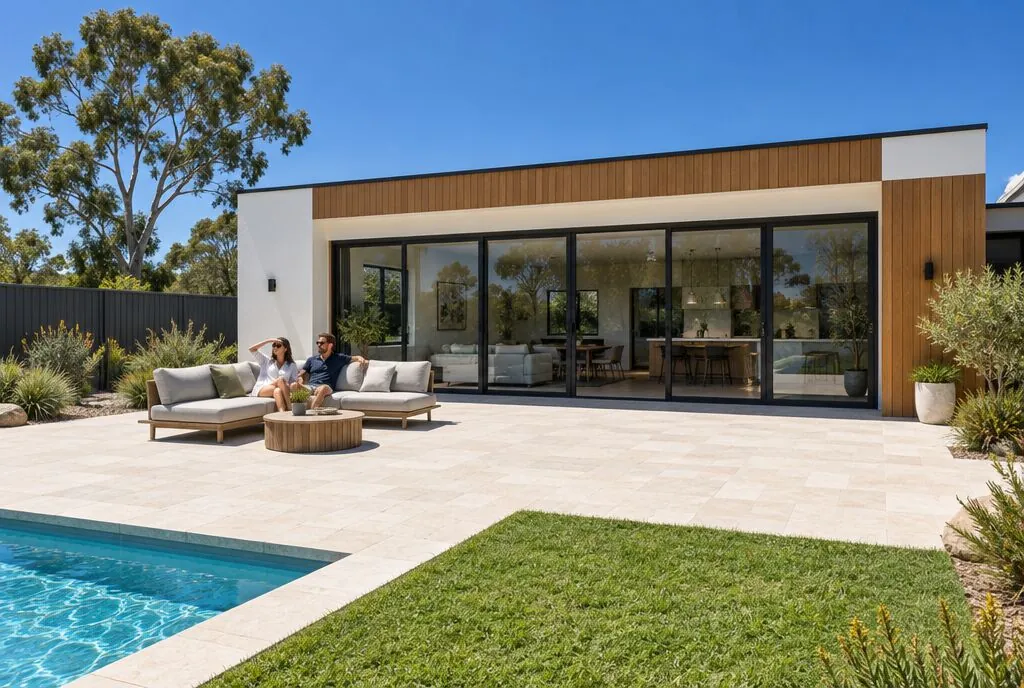
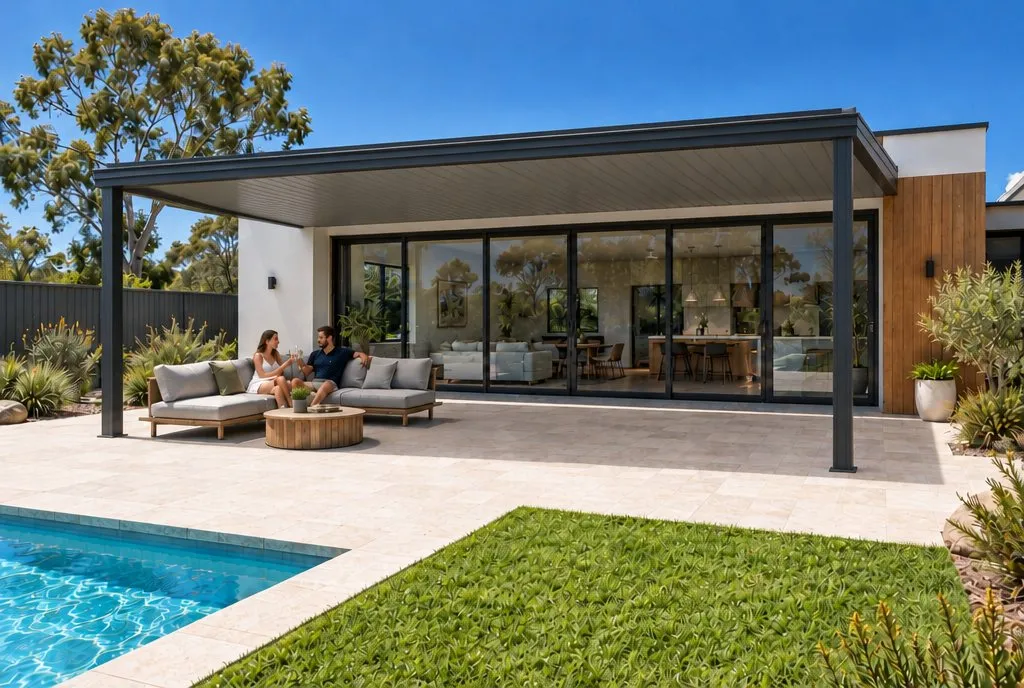 BeforeFlat Roof Colorbond Patio
In the patio vs pergola question, the key difference is the roof. In Australia, a patio is usually a solid roof, often Colorbond steel, attached to the house for full shade and rain cover. A pergola is an open or slatted frame for filtered shade, or an opening louvre roof you can adjust.
Both can be attached or freestanding, both can sit over pavers or a deck, and both need planning. Here is how they compare, what they cost in 2026, and how to pick.
Patio vs pergola at a glance
| Patio (solid roof) | Pergola (open, slatted or louvre) | |
|---|---|---|
| Roof | Colorbond steel, insulated panel or polycarbonate | Open beams, fixed slats, or opening louvre blades |
| Rain | Keeps you dry | Open and slat: no. Louvre: yes when closed |
| Shade | Full, all day | Filtered, or adjustable with louvres |
| Light into the house | Can darken nearby rooms | Lets more daylight through |
| Typical materials | Steel frame, steel roof | Timber, aluminium or steel |
| Indicative price, 6 m × 4.5 m, Perth | Flat roof: $11,500 to $13,500 | Open timber: $9,500 to $11,000 |
| Best for | Year round outdoor living | Garden feel, light, seasonal shade |
Prices are indicative installed ranges from our pricing engine. A site measure and an installer's quote set the real price.
What is a pergola?
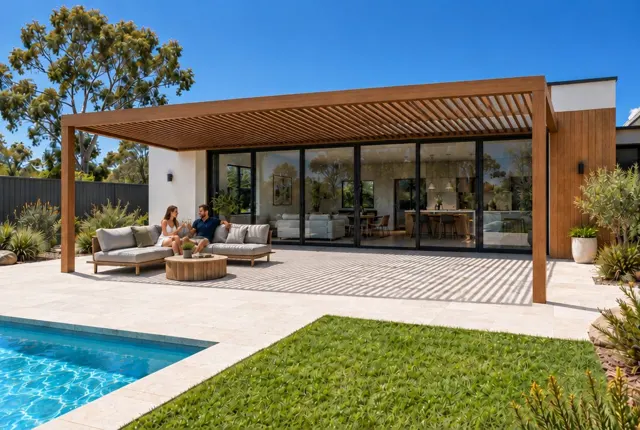
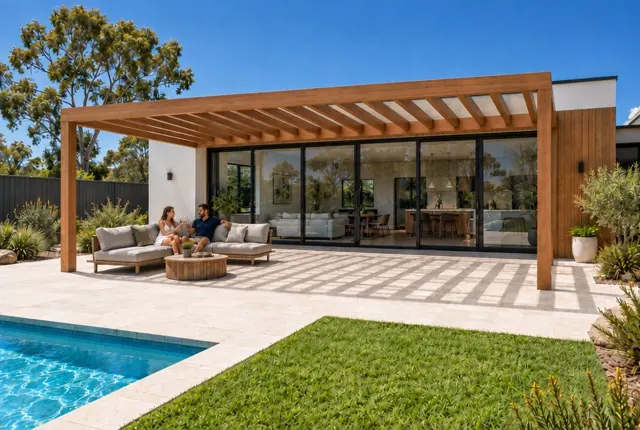
A pergola is a frame of posts and beams with an open or partly open top. Traditional pergolas use timber rafters or battens, and many people grow a vine over them or add shade cloth.
Modern pergolas often use aluminium. The two common types are fixed slats, set at an angle to block high sun, and adjustable louvres that open and close. A louvre roof is the one pergola style that can also keep out rain.
The Australian Government's YourHome guide notes that a pergola with deciduous vines or removable shade cloth gives seasonal control on the north side. You get shade in summer and sun in winter, which a solid roof cannot do.
What Australians mean by "patio"
In the US and UK, a patio is the paved area itself. In Australia, people usually use "patio" for the roof over it: a steel frame with a Colorbond or insulated roof, fixed to the house.
Patios come in several roof shapes:
- Flat roof, the simplest and most common
- Skillion, a single slope with a modern look
- Gable, a pitched triangle roof that feels taller
- Insulated, with a foam core panel that blocks heat and looks like a ceiling
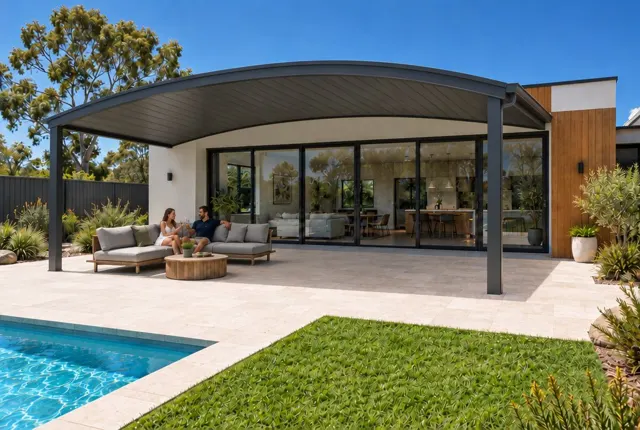
- Curved, with a bullnose style roof
Most of these can be attached to the house or freestanding, as steel makers such as Lysaght point out in their range.
Verandah, alfresco and gazebo: where they fit
Australians use several other words for outdoor roofs. They overlap a lot, so it helps to know what people usually mean.
- Verandah: a roofed, open sided area attached to the outside of a house, often along the front or sides. Queenslanders are known for wide verandahs that can wrap around the whole house. See verandah vs patio.
- Alfresco: usually a covered outdoor room built under the main roof of a newer home, next to the kitchen or living area.
- Gazebo or pavilion: a freestanding roofed structure, often with a hip or pyramid roof, set out in the garden.
Builders and councils often group patios, verandahs, carports and pergolas together, so the paperwork is similar whichever word you use.
How they compare on heat, light and rain
A solid patio roof gives the most protection. You can leave outdoor furniture out, use the space in winter rain, and fit lights, fans and heaters.
The downside is light. A wide solid roof on the north side of a house can make the kitchen or living room darker. Many patios solve this with a polycarbonate strip or skylights near the house.
A pergola keeps the space brighter and lets breezes through. But an open pergola gives patchy shade at midday and no rain cover, so furniture and cushions need to come in.
Louvre pergolas sit in the middle. You open the blades for winter sun and close them for shade or rain. YourHome notes that adjustable shading is most useful in spring and autumn, when the sun angle changes.
Patio vs pergola cost in 2026
Here are indicative installed prices for a 6 m × 4.5 m attached structure in four states.
| Style | WA | VIC | QLD | NSW |
|---|---|---|---|---|
| Flat Roof Colorbond Patio | $11,500 to $13,500 | $12,500 to $14,500 | $12,500 to $15,000 | $13,500 to $16,000 |
| Insulated Roof Patio | $15,000 to $17,500 | $15,500 to $18,500 | $16,000 to $19,000 | $17,000 to $20,000 |
| Open Timber Pergola | $9,500 to $11,000 | $10,000 to $11,500 | $10,000 to $12,000 | $11,000 to $12,500 |
| Fixed Aluminium Slat Pergola | $13,000 to $15,500 | $14,000 to $16,000 | $14,000 to $16,500 | $15,000 to $18,000 |
| Adjustable Louvre Pergola | $28,000 to $33,000 | $29,500 to $34,500 | $30,000 to $35,500 | $32,000 to $37,500 |
A basic open timber pergola usually costs a little less than a flat Colorbond patio, because it has no roof sheeting. Aluminium slats cost more, and an opening louvre roof is the most expensive option by a wide margin.
The final price depends on size, height, access, footings, council fees, engineering, electrical work and whether an old structure has to come out. For all states and sizes, see the patio cost guide and the pergola cost guide.
Council approval for patios and pergolas
Approval rules depend on your state and council, not on the word you use. In many areas an attached roofed structure needs a building permit.
For example, the Shire of Toodyay in WA says attached patios, verandahs and carports always need a building permit. Small freestanding pergolas can be exempt there. They must be 2.4 m high or less, 20 m² or less, and outside wind regions C and D.
In NSW, a patio, pergola or verandah can be exempt development if it meets set standards. These include a maximum area of 25 m², a maximum height of 3 m, and sitting behind the building line. A standard 6 m × 4.5 m structure is 27 m², so it usually needs approval there. Our council approval guide covers each state.
Which one should you choose?
Choose a patio if:
- You want to use the space in rain, or leave furniture out all year
- You need full shade on a west facing yard in a hot city like Perth or Adelaide
- You want ceiling fans, lights or heaters built in
- You want the most cover for the money
Choose a pergola if:
- The area sits in front of a living room you don't want to darken
- You want winter sun and summer shade, with a vine or shade cloth
- You like a garden or resort style look, or have a heritage home
- You only use the space in good weather
Choose an adjustable louvre pergola if you want both: rain cover when you need it and sun when you don't, and the budget allows.
Still unsure? Look at the room behind the space. If it already feels dark, lean towards a pergola or a patio with clear sections. If the yard bakes in the afternoon, a solid or insulated patio will be more comfortable.
See both on your own house
The easiest way to decide is to compare them on your actual home. With Backyard Mate, you upload one photo of your backyard and see a patio or pergola on it in about 30 seconds. You also get an indicative price for your state.
It is free, needs no account, and only one local installer calls you, and only if you ask. You can also browse the patio ideas gallery first.
Common questions
Is a pergola cheaper than a patio?
Not always. An Open Timber Pergola of 6 m × 4.5 m in Perth is indicatively $9,500 to $11,000, close to a Flat Roof Colorbond Patio at $11,500 to $13,500. An Adjustable Louvre Pergola costs far more, at around $28,000 to $33,000.
Does a pergola keep the rain out?
An open timber or slat pergola does not. An opening louvre roof sheds rain into its gutters when the blades are closed, and a solid roof patio keeps you dry all year.
What is the difference between a patio and an alfresco?
In Australian homes, an alfresco is usually a covered outdoor area built under the main house roof, often in a new build. A patio is usually added later as a separate roof attached to the house.
Can I turn my pergola into a patio later?
Sometimes. A pergola frame is often not designed for the weight and wind loads of roof sheeting, so an installer or engineer has to check the posts, beams and footings first. Many people find a new frame is simpler.
Do I need council approval for a patio or pergola?
Often, yes, especially for attached roofed structures. Rules change by state and council, and some small structures are exempt. Check our council approval guide and ask your council or a building surveyor before you build.
Keep reading
Sources
- Shading | YourHome (Australian Government)
- Balconies, decks and patios: exempt development | NSW Planning Portal
- Veranda | Wikipedia
- Patios, Pergolas & Verandahs | Lysaght
- Information sheet: patios, verandahs, carports, pergolas and shade sails | Shire of Toodyay
Prices on this page come from Backyard Mate's pricing for each state and are indicative only. Rules and products change: check with your council and installer before you build.