
Alfresco ideas for Australian homes: 8 ways to build an outdoor room you'll use all year
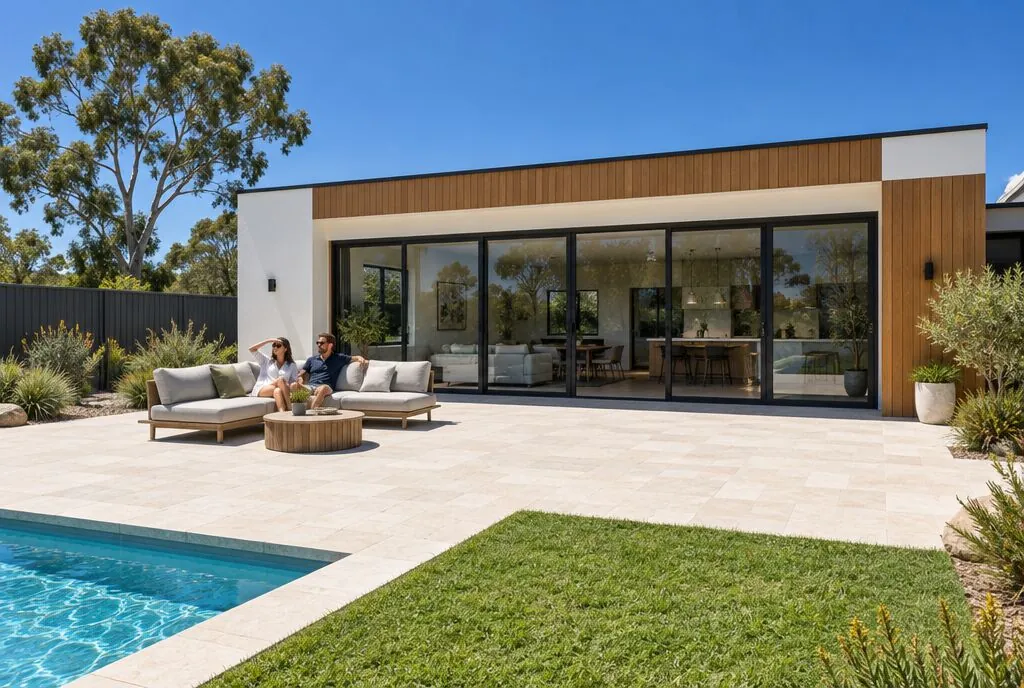
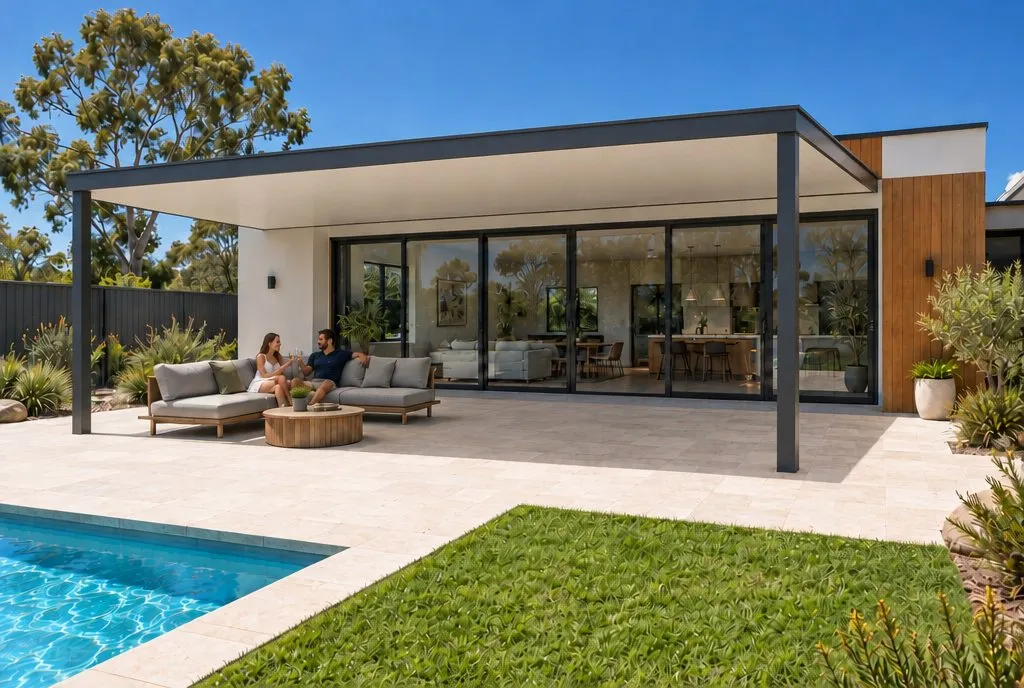 BeforeInsulated Roof Patio
The best alfresco ideas for Australian homes turn a covered area into a real outdoor room. That means a cooking zone, a dining zone, shade you can control, and light and air for summer nights.
Start with the right roof, then add the pieces in the order you will use them. Below are eight alfresco ideas, each matched to one of our patio or pergola styles, followed by what the extras cost.
8 alfresco ideas for Australian backyards
1. An outdoor kitchen under a high gable
Works best for: households who cook outside most weekends.
A gable roof patio gives you height in the middle, which suits a bench, sink and bar fridge along the house wall. Smoke and heat rise into the peak instead of sitting at head height.
Plan the services early. In NSW, plumbing, gasfitting and electrical wiring need a licensed tradesperson whatever the job costs. Other states have similar rules, so budget for licensed trades from the start.
2. A barbecue placed where the smoke can escape
Works best for: covered areas with one or two walls.
Put the barbecue near an open side, not tucked into a corner. Western Australia's guidance asks for at least 1,200 mm between a domestic barbecue's cooking surface and the roof above.
The same guidance treats a covered area as outdoors when it has four open sides, or two walls. With three walls, the open side must be at least 25% of the perimeter. The other walls also need at least 30% unrestricted opening.
A skillion patio that rises away from the house keeps the outer edge tall, right where the barbecue sits. Always follow your barbecue's manual and your state's gas rules.
3. A dining zone sized to the table
Works best for: families who eat outside most nights.
Size the roof to the table, not the paving. A table for six fits well under a 6 × 4 m roof, with room to walk around. Our patio size guide has the clearances.
A flat roof Colorbond patio is the simplest way to cover a big dining area. At 6 × 4.5 m it is about $11,500 to $13,500 installed in WA.
4. Ceiling fans and downlights in an insulated ceiling
Works best for: hot cities and west facing yards.
An insulated roof patio has a foam core panel with a flat ceiling finish underneath. It feels like an indoor ceiling, and it is the easiest roof to fit fans and downlights into.
Pick fans rated for outdoor use, and keep them clear of the barbecue's heat. Any hard wired light or fan needs a licensed electrician. Queensland's electrical safety regulator says DIY electrical work is illegal, even replacing a light switch.
BeforeInsulated Roof Patio5. Outdoor blinds for wind, rain and low sun
Works best for: west facing alfresco areas.
Blinds turn an open patio into a sheltered room. YourHome, the Australian Government's guide, says adjustable vertical shading such as external blinds is the best solution for east and west sides.
Pair blinds with an adjustable louvre pergola and you control shade from above and the side. Watch the barbecue rule above: closing blinds on three sides can change how much open area you have.
6. Slat screens for privacy
Works best for: yards overlooked by neighbours or a second storey.
A fixed aluminium slat pergola with a matching slat screen on one side gives privacy without a solid wall. Air still moves through, which helps with barbecue smoke and summer breezes.
7. Festoon lights over an open timber frame
Works best for: garden style yards and relaxed evening drinks.
An open timber pergola is a natural frame for festoon lights strung between the beams. Add low path lights and a warm wall light near the door. Layered light feels better than one bright floodlight.
8. A clear strip to keep the kitchen bright
Works best for: deep alfresco areas in front of a living room.
A wide solid roof can darken the rooms behind it. A polycarbonate roof patio, or a clear section next to the house, lets daylight through to the kitchen. YourHome notes that quite small skylights can deliver a lot of light.
Can you see these ideas on your own house?
Every house is different. A gable that looks great in a photo can clash with your roofline, and blinds can feel heavy on a small patio.
What fans, lights and blinds add to the cost
Extras are where alfresco budgets grow. Here are typical supply and install ranges:
| Extra | Typical supply and install |
|---|---|
| Lighting | $600 to $1,500 |
| Ceiling fan | $500 to $1,200 |
| Outdoor blinds | $2,500 to $6,000 |
| Gutter connection | $300 to $800 |
| Old patio removal | $500 to $2,000 |
Typical Australian ranges before any state difference. Electrical work must be done by a licensed electrician.
Lights and fans are usually the cheapest wins. Blinds cost more, but they can make the space usable through winter. Our patio extras cost guide breaks down each one.
All prices are indicative. A site measure and quote from an installer sets the real price. Size, roof type, height, access, footings, council fees, engineering and electrical work all move the final figure.
Plan the zones before you build
- Cooking: near the kitchen door, with an open side for smoke.
- Dining: in the middle, under the deepest part of the roof.
- Lounging: at the far end, where the sun reaches in winter.
- Walkways: keep about 1 m clear behind chairs and to the back door.
- Power and water: mark every power point, tap and gas point before the slab or paving goes in.
Even if you buy the fan later, ask the electrician to run the wiring while the roof goes on. It is simpler than opening things up later, and the same goes for gas and water.
See your alfresco before you spend
The quickest way to choose a roof is to see it on your own home. Backyard Mate shows a patio or pergola built on a photo of your backyard in about 30 seconds. It is free, needs no account, and only one local installer calls you, and only if you ask.
You can also browse the patio ideas gallery for more alfresco looks.
Common questions
What is the difference between an alfresco and a patio?
In Australian homes, an alfresco is usually a covered outdoor room built under the main house roof, often in a new build. A patio is usually added later as a separate roof attached to the house. Both can be fitted out the same way.
Can I put a gas BBQ under a patio roof?
Usually, if there is enough clearance and airflow. Western Australia's guidance asks for at least 1,200 mm between a domestic barbecue's cooking surface and the roof above, and sets minimum openings once the area has three walls. Your barbecue's manual and your state's gas rules have the final say.
What is the best roof for an alfresco area?
For year round use, a solid roof works best, and an insulated roof is the most comfortable in hot cities. An Insulated Roof Patio of 6 × 4.5 m is about $15,000 to $17,500 installed in WA, as an indicative range.
Can I install outdoor lights and a ceiling fan myself?
No. Hard wired lights and fans are electrical work, and in Queensland the electrical safety regulator says DIY electrical work is illegal. Use a licensed electrician in every state.
How much do outdoor blinds cost?
Outdoor blinds are one of the bigger add ons. See the extras table in this guide for typical supply and install ranges, and get a measured quote for your openings.
Keep reading
Sources
- Safe locations for using gas barbecues and gas patio heaters | Government of Western Australia
- Checking your contractor or tradesperson is qualified | NSW Government
- Don't do it yourself (DDIY) | Electrical Safety Office Queensland
- Shading | YourHome (Australian Government)
Prices on this page come from Backyard Mate's pricing for each state and are indicative only. Rules and products change: check with your council and installer before you build.